


6-Axis Articulated Welding Robots: Collaborative Automation Systems Integration
Products Description

Precision Perfected: The Robotic Revolution in Modern Arc Welding
Transforming Industrial Welding with Smart Automation
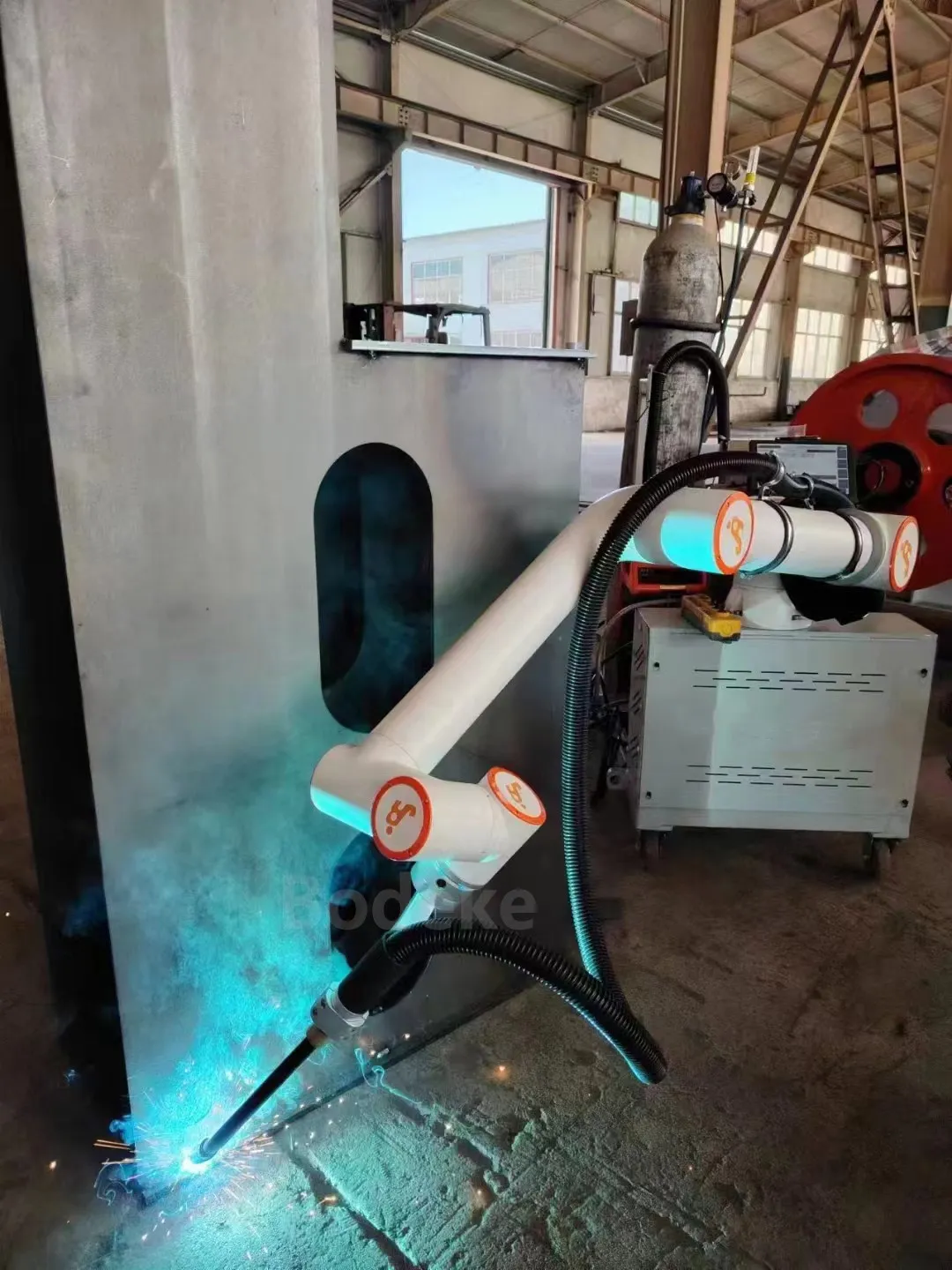
As manufacturing evolves, robotic arc welding systems have emerged as game-changers, blending precision robotics with intelligent welding technology. These advanced solutions-whether paired with adaptive pulse MIG welders or ultra-precise TIG welding systems-deliver superior weld consistency, speed, and repeatability across industries from automotive to aerospace.
System Design: The Blueprint for Precision
A state-of-the-art robotic welding cell integrates:
✔ 6-axis articulated arms with ±0.03mm repeatability
✔ Smart welding power sources featuring:
Adaptive waveform control for MIG/MAG welding
Precision arc stabilization for TIG welding machines
Energy-efficient operation (up to 30% power savings)
✔ Auxiliary welding equipment:
3D laser seam tracking for real-time path correction
Automated wire feed systems with anti-jamming tech
Integrated ventilation for fume-free operation
Performance Advantages: Beyond Human Capability
Speed & Scale
High-deposition MIG welders achieving 12m/min travel speeds
Multi-pass welding with auto-parameter adjustment
Micro-Precision Applications
Pulsed TIG systems for defect-free thin-section welding
Automated root pass control for pipe & pressure vessels
Mobility & Adaptability
Compact robotic welders for on-site fabrication
Rapid tooling change for mixed-production environments
Why Industry Leaders Choose Automation
✅ Consistency – 99.9% defect-free welds
✅ Productivity – 5X faster than manual welding
✅ Flexibility – Instant switch between MIG, TIG, and hybrid processes
✅ Safety – Eliminate operator exposure to sparks/fumes
Industry 4.0 & Smart Welding Integration
Next-gen systems now feature:
🔹 IoT-enabled monitoring – Real-time weld analytics
🔹 AI-based parameter optimization – Self-adjusting for material variations
🔹 Virtual commissioning – Digital twin simulations before deployment
🔹 Predictive maintenance – Minimize downtime with smart diagnostics
Implementation Strategy
1️⃣ Needs Assessment – Process audit & ROI modeling
2️⃣ Custom Cell Engineering – Robot/welder configuration & safety fencing
3️⃣ Process Validation – WPS qualification & trial runs
4️⃣ Seamless Deployment – Staff training & ongoing support
The Next Frontier in Welding Tech
Emerging advancements include:
Cobots (collaborative robots) for hybrid manual/auto workflows
Hyperspectral monitoring for instant defect detection
Additive welding for hybrid manufacturing applications
Final Insight:
Robotic arc welding systems, powered by intelligent MIG and TIG welding machines, are no longer optional for cutting-edge manufacturers. By adopting these automated solutions, businesses secure faster throughput, lower rework costs, and future-ready production capabilities.


Advanced Inverter Pulse MIG/MAG Welding System Technical Specifications
Compliance & Certification
This welding equipment series is manufactured in full compliance with international safety standard GB15579.1-2004 ("Arc Welding Equipment - Part 1: Welding Power Sources") and incorporates the latest innovations in arc welding technology.
Dual-Mode Welding Operation
The system features two distinct operational modes:
Precision Pulse MIG (P-MIG) Mode
Optimized for superior weld quality on:
Carbon steels (mild/low-alloy)
Austenitic stainless steel grades
Aluminum and other non-ferrous alloys
Conventional MIG Mode
Delivers exceptional performance for:
Low-spatter carbon steel welding
CO₂ gas-shielded applications
Heavy-duty fabrication work
Key Technological Features
▸ Digital Process Control System
Microprocessor-controlled arc stabilization
Real-time waveform modulation
Closed-loop arc length maintenance
▸ Intelligent Wire Feed Mechanism
Digital servo-controlled feed system
±1% speed accuracy
Anti-jamming design for consistent wire delivery
▸ Advanced Functional Capabilities
Embedded expert parameter database with:
128 preset welding programs
Auto-optimization for material/thickness combinations
Intuitive HMI interface with:
Unified parameter adjustment logic
Quick-access memory slots
▸ Enhanced Welding Performance
Spatter reduction technology (≤3% droplet expulsion)
Superior bead profile control
Thermal management system for conductive metals
▸ System Integration Options
Robot interface package (RS485/CAN bus)
Networked production monitoring
Optional peripheral integration:
Automated gas consoles
Coolant systems
Positioner controls
Technical Advantages
PWM inverter technology delivers:
92% power conversion efficiency
30% energy savings vs conventional systems
Enhanced component reliability
Four-step operational logic for:
Perfect arc initiation
Controlled weld termination
Thermal-sensitive material handling
Application Flexibility
Field-proven in:
Automotive component manufacturing
Pressure vessel fabrication
Structural steel construction
Precision metal artwork
This welding system represents the next evolution in intelligent arc welding technology, combining industrial-grade durability with precision digital control for unmatched welding performance across diverse applications.
Precautions for use
(1) The equipment number plate should be riveted at the specified position on the upper cover of the casing, otherwise the internal components will be damaged.
(2) The connection between the welding cable and the welding machine output socket must be tight and reliable. Otherwise, the socket will burn out and cause instability during welding.
(3) Avoid contact between the welding cable and metal objects on the ground to prevent short circuit of the welding machine output.
(4) Avoid damage and disconnection of the welding cable and control cable.
(5) Avoid deformation of the welding machine by impact and do not pile heavy objects on the welding machine.
(6) Ensure smooth ventilation.
(7) When used outdoors, the welding machine should be covered in rainy and snowy weather, but ventilation should not be hindered.
(8) The maximum cooling water temperature should not exceed 30ºC, and the minimum should not be frozen. The cooling water must be clean and free of impurities, otherwise it will block the cooling water circuit and burn the welding gun.
2. Regular inspection and maintenance of the welding machine
(1) Professional maintenance personnel should use compressed air to remove dust from the welding power supply once every 3 to 6 months, and pay attention to check whether there are loose fasteners in the machine.
(2) Check the cable for damage, the adjustment knob for looseness, and the components on the panel for damage.
(3) The conductive nozzle and wire feed wheel should be replaced in time, and the wire feed hose should be cleaned frequently.
3. Welding machine faults and troubleshooting
Before repairing the welding machine, the following checks should be performed:
(1) Whether the status and welding specification display on the front panel of the welding machine are correct, and whether the buttons and knobs are working properly.
(2) Whether the line voltage of the three-phase power supply is within the range of 340V~420V; whether there is a phase loss.
(3) Whether the connection of the welding machine power input cable is correct and reliable.
(4) Whether the grounding wire connection of the welding machine is correct and reliable.
(5) Whether the welding cable connection is correct and the contact is good.
(6) Whether the gas circuit is good, and whether the gas regulator or proportioner is normal.

Hot Tags: 6-axis articulated welding robots: collaborative automation systems integration, China 6-axis articulated welding robots: collaborative automation systems integration, spares for mixer truck, mixer truck chute parts, eaton pump 5423, refurbished mixer truck hydraulic pump, heavy duty mixer truck parts, working principle of mixer truck hydraulic pump
Send Inquiry
