


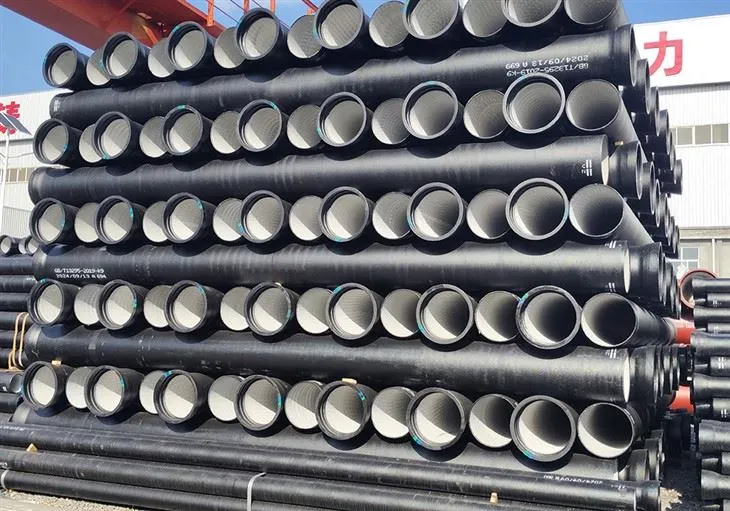


K7-K9 Pressure Class Ductile Iron Water Pipes Three-Axis Certification
$1150.00 | 1 metric tons(Min.Order)

Ductile iron pipes, as an important member of the pipe materials sector, have been widely applied in various engineering projects due to their unique performance advantages. Below is a comprehensive introduction from the two key dimensions of quality and service life.
Quality:
The quality of ductile iron pipes largely depends on their complex and precise production process. In terms of raw material selection, the quality of pig iron is crucial. The chemical composition must be strictly controlled, and impurity content must be tightly restricted to lay a solid foundation for transforming pig iron into high-quality ductile iron. The spheroidization treatment is a critical step in this process. By adding an appropriate amount of spheroidizing agent to the molten iron, graphite is uniformly distributed in a spherical shape within the iron matrix. This unique microstructure imparts excellent mechanical properties to ductile iron pipes.
High-quality ductile iron pipes exhibit outstanding strength and can withstand significant internal pressure. When used for conveying water, gas, and other fluid media, they ensure that the pipe will not rupture due to excessive pressure. Additionally, ductile iron pipes possess good toughness. Even when subjected to external impacts, such as ground settlement or vehicle overloading, they are less likely to experience brittle fractures, thereby ensuring the integrity and safety of the pipeline system.
For example, in large municipal water supply and drainage projects, ductile iron pipes must endure high pressure from the city's water system and various external forces during construction. Ductile iron pipes produced with strict quality control can operate steadily, providing reliable water supply for urban residents.

Service Life:
The material characteristics of ductile iron pipes provide them with certain advantages in terms of service life. The primary component, iron, itself has a degree of corrosion resistance. During the production process, alloy elements are added, and surface treatments are conducted to further enhance the corrosion resistance of the pipes.
In normal environments such as soil and water, ductile iron pipes can effectively resist the corrosion of various chemical substances. For example, in typical underground drainage projects, ductile iron pipes laid underground can last between 30 to 50 years under normal maintenance and usage conditions. This means that the pipes do not need to be replaced frequently over a long period, reducing the long-term maintenance costs and environmental impact.

However, it is important to note that the service life of ductile iron pipes is significantly affected by the usage environment. If pipes are constantly exposed to strongly acidic or alkaline soil conditions, acidic or alkaline substances may chemically react with the surface of the pipe, accelerating the corrosion process. High-temperature environments can also damage the pipes, potentially causing changes in the metallurgical structure and impacting their mechanical and corrosion resistance properties. Therefore, in special working conditions, it is essential to fully consider the environmental factors that affect the service life of ductile iron pipes, conducting a comprehensive evaluation based on the specific environmental conditions to ensure the long-term stable operation of the project.
In conclusion, ductile iron pipes are a reliable material choice that can meet the quality and service life requirements in most conventional engineering scenarios. However, when facing special working conditions, it is important to carefully assess their suitability to achieve the best engineering results. Could you clarify which type of project you are considering using ductile iron pipes for? Is it a municipal project, an industrial project, or another field? The performance requirements for ductile iron pipes can vary across different sectors, and we can delve into further discussion.
| High-quality Ductile iron Pipe Parameters. | |||||||
| Specification | K7 Wall Thickness/mm | K8 Wall Thickness/mm | K9 Wall Thickness/mm | Theoretical Weight/Ton | |||
| Nominal Wall Thickness | Minimum Wall Thickness | Nominal Wall Thickness | Minimum Wall Thickness | Nominal Wall Thickness | Minimum Wall Thickness | ||
| DN80 | / | / | / | / | 6 | 4.7 | 0.077 |
| DN100 | 4.2 | 2.9 | 4.8 | 3.5 | 6 | 4.7 | 0.095 |
| DN150 | 4.55 | 3.25 | 5.2 | 3.9 | 6 | 4.7 | 0.144 |
| DN200 | 4.9 | 3.6 | 6.5 | 4.3 | 6.3 | 4.8 | 0.194 |
| DN250 | 5.25 | 3.95 | 6 | 4.7 | 6.8 | 5.25 | 0.255 |
| DN300 | 5.6 | 4.3 | 6.4 | 4.8 | 7.2 | 5.6 | 0.323 |
| DN350 | 5.95 | 4.65 | 6.8 | 5.15 | 7.7 | 6.05 | 0.403 |
| DN400 | 6.3 | 4.6 | 7.2 | 5.5 | 8.1 | 6.4 | 0.482 |
| DN450 | 6.65 | 4.9 | 7.6 | 5.85 | 8.6 | 6.85 | 0.577 |
| DN500 | 7 | 5.2 | 8 | 6.2 | 9 | 7.2 | 0.669 |
| DN600 | 7.7 | 5.8 | 8.8 | 6.9 | 9.9 | 8 | 0.882 |
| DN700 | 8.4 | 6.4 | 9.4 | 7.6 | 10.8 | 8.8 | 1.123 |
| DN800 | 9.1 | 7 | 10.4 | 8.3 | 11.7 | 9.6 | 1.394 |
| DN900 | / | / | 11.2 | 9 | 12.6 | 10.4 | 1.691 |
| DN1000 | / | / | 12 | 9.7 | 13.5 | 11.2 | 2.017 |
| DN1200 | / | / | 13.6 | 11.1 | 15.3 | 12.8 | 2.758 |
| DN1400 | / | / | 15.2 | 12.5 | 17.1 | 14.4 | 3.669 |
| DN1500 | / | / | 16 | 13.2 | 18 | 15.2 | 4.175 |
| DN1600 | / | / | 16.8 | 13.9 | 18.9 | 16 | 4.668 |
| DN1800 | / | / | 18.4 | 15.3 | 20.7 | 17.6 | 5.803 |
| DN2000 | / | / | 20 | 16.7 | 22.5 | 19.2 | 7.043 |
| DN2200 | / | / | 21.6 | 18.1 | 24.3 | 20.8 | 8.332 |
| DN2400 | / | / | 23.2 | 20.3 | 26.1 | 22.4 | 9.822 |
| DN2600 | / | / | 24.8 | 20.9 | 27.9 | 24 | 11.392 |
| K7, K8, and K9 are all calculated based on the same theoretical weight. | |||||||
| Pressure - Bearing Performance Parameters of Ductile Iron Pipes | |||||||
| DN | DE(mm) | Pressure Rating | Radial Rigidity (KN/M²) |
Nominal Wall Thickness (mm) |
PFA MPA |
PAM MPA |
PEA MPA |
| DN80 | 98 | C40 | 856 | 4.4 | 4.0 | 4.8 | 5.3 |
| DN100 | 118 | C40 | 481 | 4.4 | 4.0 | 4.8 | 5.3 |
| DN125 | 144 | C40 | 271 | 4.5 | 4.0 | 4.8 | 5.3 |
| DN150 | 170 | C40 | 163 | 4.5 | 4.0 | 4.8 | 5.3 |
| DN200 | 222 | C40 | 84 | 4.7 | 4.0 | 4.8 | 5.3 |
| DN250 | 176 | C30 | 52 | 4.9b | 3.0 | 3.6 | 4.1 |
| DN300 | 326 | C30 | 34 | 5.1 | 3.0 | 3.6 | 4.1 |
| DN350 | 378 | C30 | 44 | 6.3b | 3.0 | 3.6 | 4.1 |
| DN400 | 429 | C25 | 34 | 6.5b | 3.0 | 3.6 | 4.1 |
| DN450 | 480 | C25 | 23 | 6.5b | 2.5 | 3.0 | 3.5 |
| DN500 | 532 | C25 | 17 | 6.5 | 2.5 | 3.0 | 3.5 |
| DN600 | 635 | C25 | 17 | 7.6b | 2.5 | 3.0 | 3.5 |
| DN700 | 738 | C25 | 17 | 8.8b | 2.5 | 3.0 | 3.5 |
| DN800 | 842 | C25 | 15 | 9.6 | 2.5 | 3.0 | 3.5 |
| DN900 | 945 | C25 | 15 | 10.6 | 2.5 | 3.0 | 3.5 |
| DN1000 | 1048 | C25 | 14 | 11.6 | 2.5 | 3.0 | 3.5 |
| DN1100 | 1152 | C25 | 14 | 12.6 | 2.5 | 3.0 | 3.5 |
| DN1200 | 1255 | C25 | 14 | 13.6 | 2.5 | 3.0 | 3.5 |
| DN1400 | 1462 | C25 | 14 | 15.7 | 2.5 | 3.0 | 3.5 |
| DN1500 | 1565 | C25 | 14 | 16.7 | 2.5 | 3.0 | 3.5 |
| DN1600 | 1668 | C25 | 13 | 17.7 | 2.5 | 3.0 | 3.5 |
| DN1800 | 1785 | C25 | 13 | 19.7 | 2.5 | 3.0 | 3.5 |
| DN2000 | 2082 | C25 | 13 | 21.8 | 2.5 | 3.0 | 3.5 |
| DN2200 | 2288 | C25 | 13 | 23.8 | 2.5 | 3.0 | 3.5 |
| DN2400 | 2495 | C25 | 13 | 25.8 | 2.5 | 3.0 | 3.5 |
| DN2600 | 2702 | C25 | 13 | 27.9 | 2.5 | 3.0 | 3.5 |
| DN2800 | 2908 | C25 | 13 | 29.9 | 2.5 | 3.0 | 3.5 |
| DN3000 | 3115 | C25 | 13 | 31.9 | 2.5 | 3.0 | 3.5 |
Hot Tags: k7-k9 pressure class ductile iron water pipes three-axis certification, China k7-k9 pressure class ductile iron water pipes three-axis certification, SAUER PV23, pv22 hydraulic pump, Sauer PV090 pump, Eaton 5423, Sauer PV090, MCSORRY MA4V090
Send Inquiry
